

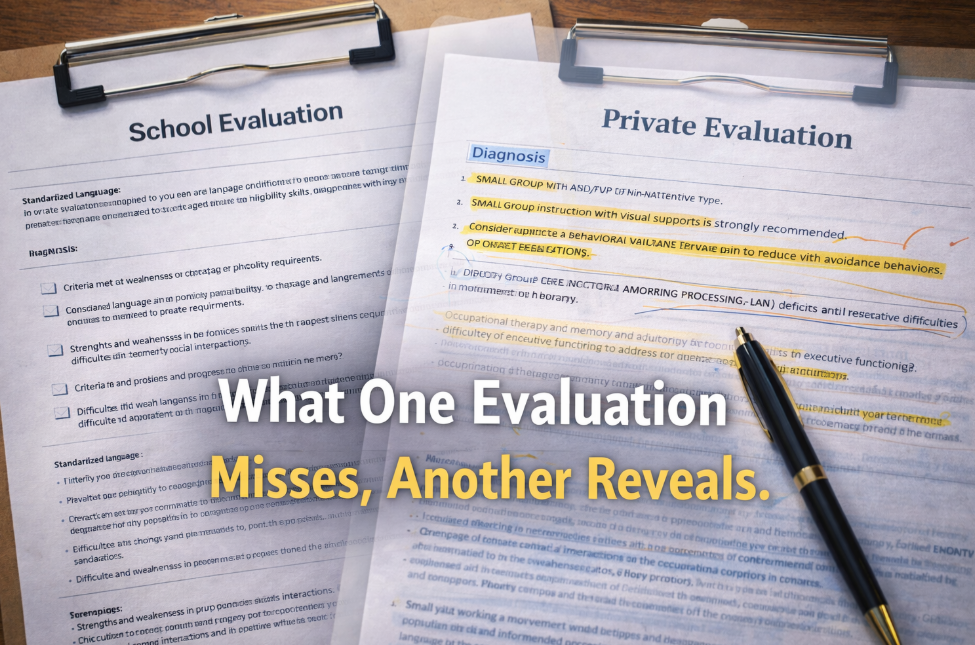
When a child is struggling, evaluation results can make all the difference.
They shape how needs are identified, how goals are written, and what services are appropriate to meet a student’s individualized educational needs.
Understanding the difference between what a school evaluation provides, and what a private evaluation can add, is one of the most useful tools a parent can have.
What School Evaluations Are Designed to Do
When done correctly, school evaluations serve a specific, 2-fold purpose: to determine eligibility for special education; and to support the planning and development of appropriate educational programming for a student.
A school-based evaluation, often referred to as a Case Study Evaluation, is used to determine whether a student is “eligible” to receive special education services and supports. Results from the evaluation are then used to support the development of appropriate educational programming for a student, including among other things, individualized goals; related-services; and educational programming/placement.
What Private Evaluations Can Add
A private evaluation is conducted outside the school system, funded privately, and can include a variety of evaluation types (e.g., Psychological Evaluations; Neuropsychological Evaluations; Psychiatric Evaluations; Speech Language Evaluations; Occupational Therapy Evaluations; Behavioral Evaluations, etc.).
Depending on how comprehensive a school-based evaluation is, private evaluations may provide a more in-depth analysis, and more detailed recommendations to support educational planning for a student.
Private evaluations may provide:
- More comprehensive testing across cognitive, academic, and social/emotional areas (e.g., if there are specific concerns about a potential learning disability in basic reading skills, such as decoding/encoding (dyslexia), a private evaluation may include more in depth measures to assess these areas.
- Clinical context that helps explain patterns of difficulty.
- Specific recommendations tied to how the child learns and what is needed to make meaningful growth.
- A diagnosis, where applicable, that clarifies an underlying need. A school-based evaluation only addressed “eligibility”, it cannot provide a diagnosis.
Where Schools Tend to Push Back
While schools are required to review and consider all private evaluations submitted to them, a school is not specifically required to accept the findings and/or recommendations from a private evaluation, and sometimes doesn’t.
For this reason it is very important “how” an evaluation is provided to a school district and “who” is present when the evaluation is reviewed by a school team.
When a private evaluation is provided to a school, a school may request the opportunity to initiate their own evaluation of the student. This route is often used when a student is not yet eligible for special education, or when no evaluation has yet been completed by a school district to determine a student’s eligibility for special education.
How to Present Outside Findings Effectively
Walking into a meeting and simply handing over a private report, is not recommended. The school should be afforded time to review the report in advance; and a meeting should then be scheduled to review the report together, and if at all possible, the evaluator should be present to review their findings; provide recommendations; and answer questions presented.
When a private evaluation is completed, to be most helpful to support educational planning, the evaluation report should:
- Summarize the key findings in plain language
- Connect recommendations to eligibility determinations, and if recommending eligibility for special education, then specific IEP components, such as individualized goals; related-services/minutes; supplementary aides, accommodations, and supports; and educational programming/placement.
- Ask the team to address each recommendation directly, either by incorporating it or explaining in writing why they disagree.
- Follow up in writing after the meeting to document what was discussed and how findings were or weren’t incorporated.
When a Special Education Attorney Can Make the Difference
If a school is resistant to private evaluation findings, working with a special education attorney can shift the dynamic.
An attorney understands how to present outside findings in a way that carries legal weight, can identify when a school’s response falls short of its obligations under IDEA, and can help ensure the evaluation record is being used as effectively as possible. When the stakes are high, that guidance can mean the difference between findings that sit in a folder and findings that drive real change.