

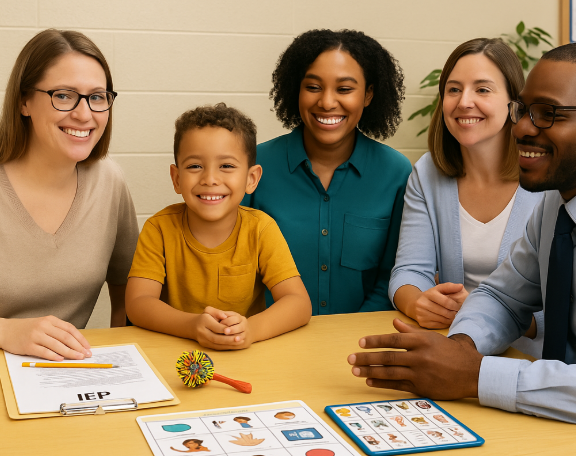
A vital and sometimes overlooked component of special education is the array of related services that help students succeed both in and out of the classroom. Related services are not supplemental extras—they are essential services that support a child’s ability to access and benefit from their education.
What Are Related Services?
Under the Individuals with Disabilities Education Act (IDEA), related services are defined as developmental, corrective, and other supportive services required to help a child with a disability benefit from special education.
These services are documented in a student’s Individualized Education Program (IEP) and are customized based on their educational goals and functional needs.
Related services can include:
- Speech-Language Services to support communication needs.
- Occupational Therapy (OT) to help with fine motor skills, motor planning, visual perception, sensory processing, and activities of daily living.
- Physical Therapy (PT) to assist with mobility and overall gross motor development.
- Counseling Services to address social/emotional and behavioral challenges, and may be delivered by a school social worker or school psychologist..
- Transportation Services to provide access to and from school as well as within a school setting.
- Audiology and Vision Itinerant Services for students with visual and/or hearing impairments.
Related services can be provided to a student 1:1, in a small group setting, or in combination, based on a student’s individualized needs. Related services can include direct services with a student, as well as consult services from a related service provider to a student’s educational team.
They are designed to meet a student’s individualized needs across a school setting, reducing barriers to learning, and promoting meaningful progress for a student at school.
Determining the Right Services
During the IEP process, the team identifies which related services are necessary for the student to make meaningful progress in their education. Assessments, observations, and input from professionals such as therapists or psychologists help determine what services will be most beneficial.
Each service is documented in the IEP, including how often it will occur, who will provide it, and whether it will be delivered individually or in a group. The IEP must clearly explain how these services relate to the student’s goals so that progress can be monitored.
A Collaborative Approach
Related service providers often work closely with teachers and school staff to integrate strategies into daily routines.
For example, an occupational therapist might help a teacher adapt classroom tools to accommodate a student’s motor skills, or a speech-language pathologist might provide in-class modeling of communication strategies.
This collaboration supports a more inclusive and effective learning environment, making sure that the student’s educational experience is comprehensive and coordinated.
Related services in special education are far more than just therapy sessions or transportation logistics. They are integral components of a student’s educational support system, helping them engage, participate, and grow.
When families understand the scope and purpose of related services, they are better equipped to advocate for what their child needs.
About Ancel Reiter LLC
Whether through Special Education Legal Representation or Child & Family Advocacy Services, our central goal is to empower parents and their children with the knowledge to find success at school, at home, and in the community. Our legal practice focuses on special education law and related issues in the greater Chicago area: Cook County, Lake County, DuPage County and throughout Illinois.
For more information, contact us today.